PFAS Factsheet
Section 1: Information about PFAS
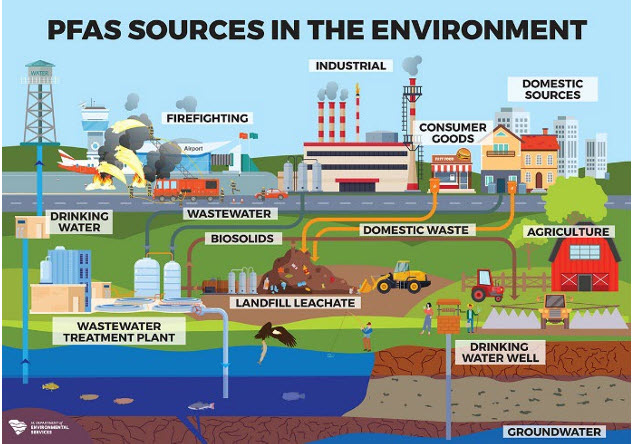
Per- and polyfluoroalkyl substances (PFAS) are a class of emerging contaminants made up of several thousand compounds. Emerging contaminants are pollutants that affect the quality of drinking water but are not yet regulated by the EPA. PFASs were developed in the 1930s, came into widespread use in the 1950s, and EPA first became aware of the health effects associated with PFAS in 1998. Due to their use in consumer and commercial applications such as firefighting foams, stain repellants for clothing and carpets, and other sources, these chemicals are being detected in drinking water, groundwater, surface water, landfills, and air.
PFAS compounds are commonly found in ground, surface, and drinking water because they are widely used. They are found in a wide variety of household products and can cause contamination when they enter wastewater or landfills. The manufacturing processes used to make these products can also release PFAS.
Additionally, some products are used in ways that pose a direct risk to ground or surface water. A leading cause of PFAS contamination is firefighting foams, which can enter groundwater when used on an outdoor fire. Although new regulations limit PFAS in some products, older commercial products containing PFAS continue to pose a risk.
NDEP has not identified any industries in Nevada that have manufactured PFAS. Historical manufacturing could have used and/or released PFAS through different processes. Certain coatings and fluids manufacturing may have included PFAS. Many metal plating operations have historically used or still use PFAS for worker safety (e.g., hexavalent chromium plating).
Aside from drinking water, Nevada does regulate and restrict PFAS use. Since January 1, 2022, the use or release of class B firefighting foams containing PFAS for testing or training has been prohibited. Nevada will follow EPA’s drinking water regulation regarding PFAS to ensure the continued safety of Nevadans’ drinking water.
Since 2021, the Nevada Legislature directed the State to develop and implement a PFAS Action Plan. Detailed information about ongoing efforts can be found at: PFAS in Nevada | NDEP
Section 2: PFAS National Primary Drinking Water Regulation (NPDWR)
The PFAS NPDWR establishes enforceable drinking water standards to limit PFAS contamination in public water systems. The EPA has set Maximum Contaminant Levels (MCLs) for key PFAS compounds, including PFOA and PFOS at 4.0 parts per trillion (ppt), along with additional limits for other PFAS chemicals and mixtures.
Key Regulatory Requirements
- Monitoring & Reporting: Public water systems must conduct initial PFAS sampling and report findings to the EPA.
- Compliance Deadlines: Systems must comply with the new MCLs within a set timeframe or implement mitigation strategies.
- Public Notification: If PFAS levels exceed MCLs, water providers must inform the public and take corrective actions.
- Treatment & Remediation: Systems detecting PFAS contamination must evaluate and apply appropriate treatment technologies.
Implementation Timeline
- 2023–2027: Initial PFAS monitoring and data collection.
- 2029: Compliance deadlines for public water systems to meet new PFAS limits.
- Ongoing: Annual reporting, public notifications, and enforcement actions for non-compliance.
Section 3: MCL Reference Table
| Compound | Proposed MCL |
|---|---|
| PFOA | 4.0 ppt |
| PFOS | 4.0 ppt |
| PFNA | 10 ppt |
| PFHxS | 10 ppt |
| HFPO-DA (GenX) | 10 ppt |
| Mixtures containing two or more of PFHxS, PFNA, HFPO-DA, and PFBS | 1.0 (unitless Hazard Index) |
MCL = Maximum Contaminant Level – the highest level of a contaminant allowed in drinking water
ppt = parts per trillion – equivalent to ng/L (nanogram per liter)
Section 4: Nevada’s PFAS Sampling Program
Nevada has proactively addressed PFAS contamination through a statewide PFAS Sampling Program to assess the presence of these chemicals in public water supplies. The program aims to:
- Identify PFAS contamination hotspots through voluntary sampling initiatives.
- Provide technical assistance and guidance to impacted water systems.
- Support water providers with funding and treatment solutions to comply with future regulations.
- Collaborate with local and federal agencies to develop long-term mitigation strategies.
Importance for Public Water Systems
Ensuring compliance with the PFAS NPDWR and participating in Nevada’s PFAS Sampling Program are essential steps in safeguarding drinking water, securing funding for treatment solutions, and maintaining regulatory compliance. Public water systems should proactively monitor water sources, evaluate treatment options, and collaborate with regulators to ensure a smooth transition to the new standards.
Section 5: Nevada Interim Household Treatment
The Nevada Interim Treatment Grant Funding serves Nevada’s communities by providing free drinking water filters for customers of public water systems who have tested over the MCL for PFOA, PFOS, PFNA, PFHxS, HFPO-DA, or the Hazard Index.
By offering free household filters, this funding ensures residents have access to safe drinking water until long-term solutions are implemented.
To see if you qualify for a free filter, visit: [INSERT LINK]
References and Resources
- ASDWA’s website – includes a PFAS Technical Appendix, Mapping Guidance, and Decision Support Tool
- NDEP Bureau of Water Quality Planning PFAS website – updated PFAS initiatives, statewide sampling results, funding opportunities, and more
- Communicating with Industry on PFAS Contamination, SDWA 2021, ASDWA/CADMUS
- CWSRF Emerging Contaminants – Frequent Questions and Answers | US EPA